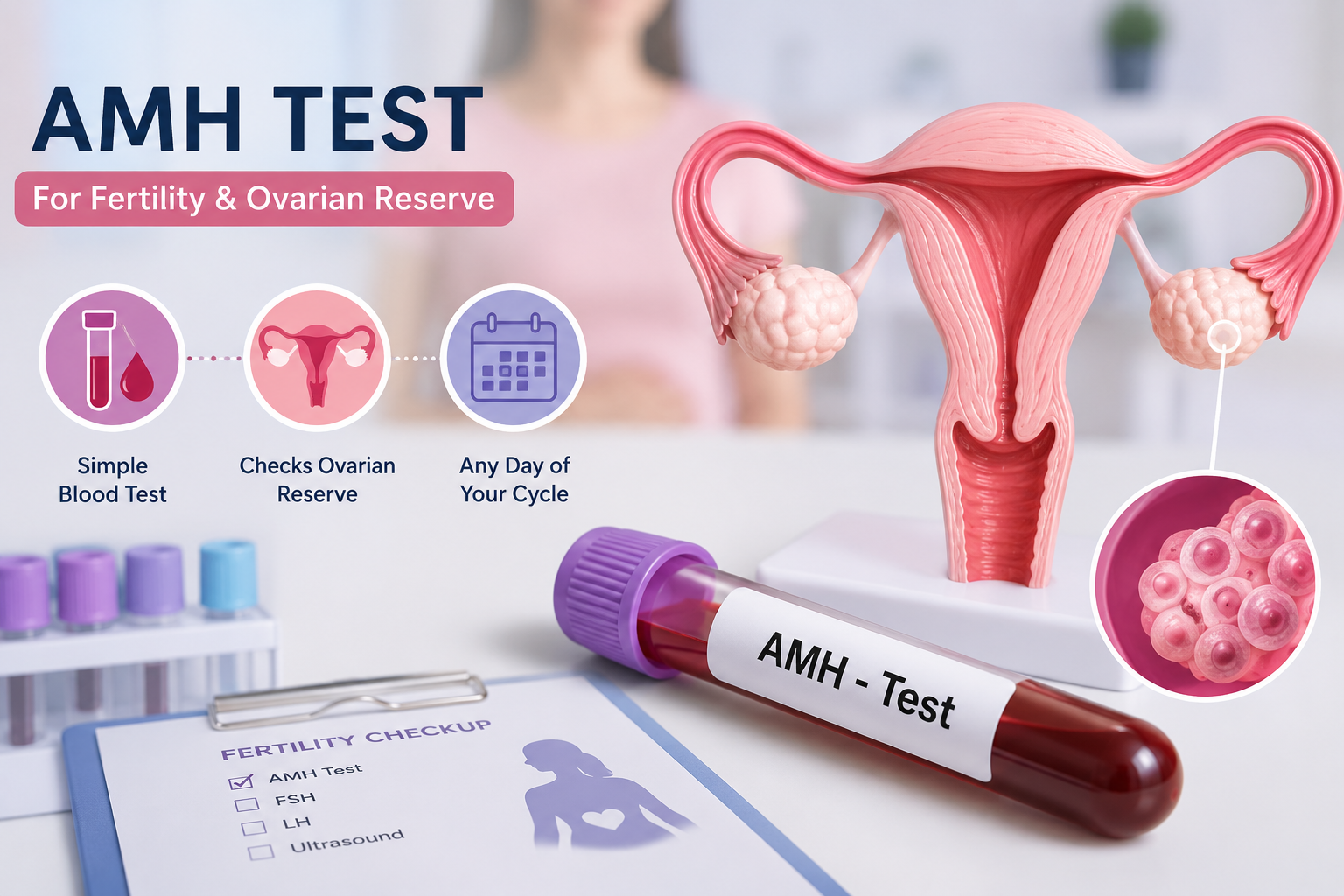
For many couples trying to conceive, fertility testing is often the first step toward understanding their reproductive health. Among the various fertility assessments available today, the AMH Test in Ahmedabad has become one of the most commonly recommended tests for women who are planning pregnancy or considering fertility treatment.
Anti-Müllerian Hormone (AMH) plays an important role in evaluating a woman's ovarian reserve, which refers to the number of eggs remaining in the ovaries. While AMH levels do not directly determine whether you can get pregnant, they provide valuable insights into fertility potential and help fertility specialists recommend the most suitable treatment options.
If you have recently been advised to undergo an AMH Test in Ahmedabad, understanding what the results mean can help you make informed decisions about your fertility journey.
AMH, or Anti-Müllerian Hormone, is produced by small follicles present in a woman's ovaries. The hormone level in the blood reflects the number of developing follicles and provides an estimate of ovarian reserve.
Unlike many other reproductive hormones, AMH levels remain relatively stable throughout the menstrual cycle. This means the test can usually be performed on any day of the cycle.
The AMH Test in Ahmedabad is often recommended for:
Why Is AMH Important for Fertility?
A woman's fertility naturally declines with age due to a reduction in both egg quantity and egg quality. AMH helps doctors estimate how many eggs remain in the ovaries.
The AMH test can help:
The test provides an indication of the remaining egg supply.
AMH levels help fertility specialists determine how the ovaries may respond to fertility medications during IVF.
Low AMH may indicate reduced ovarian reserve, while high AMH levels may suggest conditions such as Polycystic Ovary Syndrome (PCOS).
Women who wish to delay pregnancy may benefit from understanding their fertility status early.
Many women undergoing an AMH Test in Ahmedabad want to know whether their results are normal.
Although reference ranges may vary slightly among laboratories, the following ranges are commonly used:
| AMH Level | Interpretation |
|---|---|
| Above 4.0 ng/ml | High ovarian reserve |
| 1.5 – 4.0 ng/ml | Normal ovarian reserve |
| 1.0 – 1.5 ng/ml | Low-normal ovarian reserve |
| 0.5 – 1.0 ng/ml | Low ovarian reserve |
| Below 0.5 ng/ml | Significantly diminished ovarian reserve |
Generally, AMH levels between 1.5 and 4.0 ng/ml are considered favorable for fertility and pregnancy planning.
However, it is important to understand that AMH is only one part of the fertility picture.
One of the biggest misconceptions surrounding fertility is that low AMH means pregnancy is impossible.
In reality, many women with low AMH levels conceive naturally and through fertility treatments.
AMH primarily measures egg quantity rather than egg quality. Younger women with low AMH may still have healthy eggs capable of successful fertilization and pregnancy.
Factors that influence pregnancy chances include:
Therefore, low AMH should not be viewed as a definitive barrier to pregnancy.
While higher AMH levels generally indicate a larger ovarian reserve, extremely high levels may be associated with PCOS.
Women with PCOS often have:
A high AMH result should always be interpreted alongside other clinical findings and ultrasound examinations.
Age remains one of the most important fertility factors.
Typical AMH levels tend to decline as women grow older.
Most women in this age group have healthy ovarian reserves and higher AMH levels.
A gradual decline in AMH levels may begin, though fertility often remains relatively good.
Ovarian reserve starts decreasing more rapidly, making fertility evaluation increasingly important.
Lower AMH levels become more common, and fertility specialists may recommend timely fertility treatment if conception has not occurred.
This is why many fertility experts recommend an AMH Test in Ahmedabad for women planning delayed parenthood.
An AMH test may be beneficial if:
Women under 35 who have been trying for one year and women above 35 who have been trying for six months should consider fertility evaluation.
Irregular cycles may indicate ovulation-related issues that warrant further investigation.
AMH helps fertility specialists estimate ovarian response and personalize treatment protocols.
AMH can assist in understanding ovarian function and fertility potential.
Women considering delayed pregnancy may use AMH testing as part of fertility planning.
The AMH Test in Ahmedabad is a simple blood test.
The process typically involves:
No fasting is generally required, and the test can often be performed at any time during the menstrual cycle.
The procedure is quick, safe, and minimally invasive.
No.
While AMH provides valuable information, fertility specialists typically combine it with other assessments.
These may include:
A transvaginal ultrasound evaluates visible follicles in the ovaries.
Follicle Stimulating Hormone helps assess ovarian function.
Luteinizing Hormone evaluation helps understand ovulation patterns.
Thyroid disorders can affect fertility and pregnancy.
Male fertility factors contribute significantly to conception outcomes.
A comprehensive fertility evaluation offers a more accurate picture than AMH alone.
Many couples considering IVF are advised to undergo an AMH Test in Ahmedabad before treatment begins.
AMH helps fertility specialists:
However, IVF success depends on multiple factors, including:
A woman with lower AMH may still achieve successful IVF outcomes with appropriate treatment planning.
Although AMH levels themselves cannot usually be increased significantly, certain lifestyle measures may support overall reproductive health.
Both obesity and being underweight can affect fertility.
A nutrient-rich diet supports hormonal balance and reproductive function.
Moderate physical activity contributes to overall health.
Smoking is associated with accelerated ovarian aging.
Chronic stress can negatively affect reproductive health and overall well-being.
Early identification of fertility concerns often improves treatment outcomes.
Many women with low AMH conceive naturally or with fertility treatment.
High AMH indicates ovarian reserve but does not guarantee conception.
AMH primarily reflects egg quantity, not quality.
A complete fertility evaluation requires multiple assessments.
Seeking professional guidance may be beneficial if:
An experienced fertility specialist can interpret AMH results within the context of your overall reproductive health and recommend appropriate next steps.
The AMH Test in Ahmedabad is a valuable tool for understanding ovarian reserve and fertility potential. While AMH levels provide important information about egg quantity, they do not tell the complete story of fertility.
A normal AMH level can be reassuring, while low or high levels may indicate the need for further evaluation. However, factors such as age, egg quality, overall health, and reproductive history are equally important when assessing pregnancy chances.
For women planning pregnancy, experiencing infertility, or considering fertility treatment, an AMH test can provide useful insights and help guide future reproductive decisions. When interpreted by a fertility specialist alongside other diagnostic tests, AMH becomes an important part of a comprehensive fertility assessment.