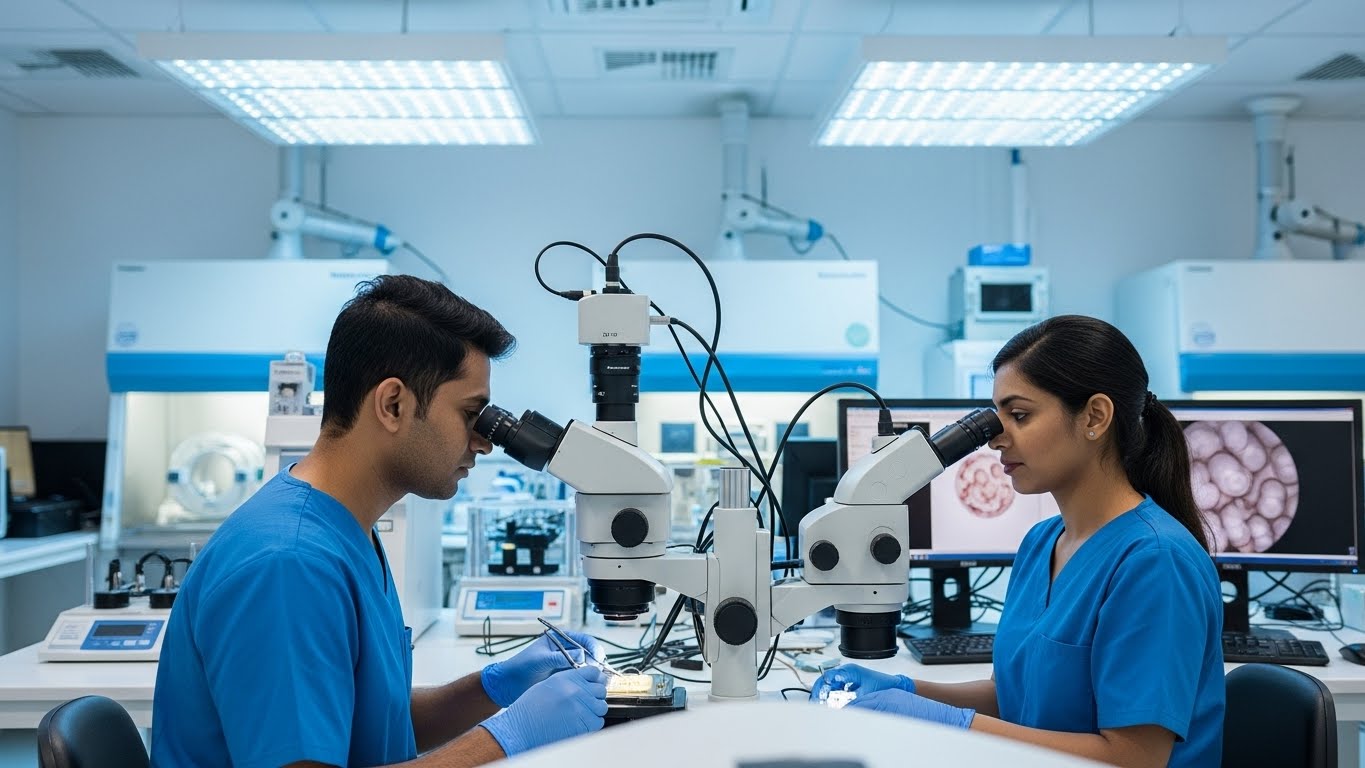
When couples undergo IVF or fertility treatment, much of the most critical work happens outside the consultation room inside the IVF laboratory. This is where eggs are fertilized, embryos develop, and scientific precision meets hope. Yet for most patients, the IVF lab remains a mystery. People often hear terms like ICSI, blastocyst, or embryo grading without fully understanding what they mean or why they matter. Knowing what happens behind the lab door helps patients feel informed, confident, and reassured during treatment. At Neev IVF Center in Ahmedabad, assisted reproductive technology (ART) is guided by strict protocols, advanced equipment, and experienced embryologists because small lab details can significantly influence outcomes.
Assisted Reproductive Technology refers to medical procedures used to achieve pregnancy by handling eggs, sperm, or embryos outside the body.
ART includes:
While doctors design treatment plans, the IVF lab executes them with precision.
The IVF lab replicates conditions similar to the human body. Tiny changes in temperature, humidity, or air quality can affect embryo development.
A high-quality lab ensures:
This is why IVF success is influenced not just by medical decisions but by laboratory standards.
Once eggs are retrieved, they are immediately transferred to the lab. Embryologists:
Eggs are extremely sensitive and must be handled within strict time limits.
Sperm samples are processed to:
This step improves fertilization potential.
Depending on medical indication:
ICSI is commonly used in male infertility or previous fertilization failure.
After fertilization, embryos are placed in incubators that mimic the uterine environment.
Embryologists monitor:
Embryos are typically cultured for 3 to 5 days.
By day 5, embryos may reach the blastocyst stage, which allows:
Not all embryos reach this stage and that is normal.
Embryo grading helps embryologists assess:
Grading guides embryo selection but does not guarantee pregnancy. Even lower-graded embryos can result in healthy pregnancies.
At Neev IVF Center, grading is used as a tool not a promise.
Cryopreservation allows embryos to be safely stored for future use.
Embryos may be frozen when:
Frozen embryos remain viable for years when stored properly.
FET allows embryo transfer in a later cycle when:
Many patients achieve pregnancy through frozen transfers.
A reliable IVF lab maintains:
Even brief lab disruptions can affect outcomes.
Embryologists are the unseen experts behind IVF success. Their role includes:
Their experience directly influences lab success rates.
“More embryos mean better chances.”
Quality matters more than quantity.
“Lab technology guarantees pregnancy.”
Technology supports but biology decides.
“Embryos are damaged during freezing.”
Modern vitrification preserves embryo quality effectively.
Waiting for fertilization updates can be stressful. Patients often feel anxious during:
Clear communication helps reduce uncertainty during this phase.
ART outcomes depend on:
At Neev IVF Center in Ahmedabad, lab practices prioritize safety, transparency, and patient trust.
Assisted Reproductive Technology is a blend of science, skill, and precision. While patients may never enter the IVF lab, understanding what happens inside it builds confidence in the process.
IVF success is not accidental it is the result of countless controlled lab decisions made every day. With advanced laboratory standards and experienced teams, fertility centers help transform possibility into reality.
Clinics like Neev IVF Center focus on doing the unseen work right because every detail matters.